
Supply Chain Responsibility
NS places great importance on supply chain responsibility and has therefore developed a Policy and a Supplier Code of Conduct to ensure that everyone in the chain complies with OECD Guidelines for Multinational Enterprises on Responsible Business Conduct. There are three core principles serving as the foundation:

Respect for human rights and labour standards: These rights and standards include a safe and healthy working environment, no forced or child labour, equal treatment, fair wages, reasonable working hours, and freedom of association.

Limiting environmental impact: Suppliers are expected to minimize their effects on water, air, and soil, and to contribute to CO2 and energy reduction, the circular economy, biodiversity, forest conservation, and animal welfare.

Integrity and fair business practices:This is reflected in fair competition, the absence of bribery and corruption, transparency, the protection of privacy and cybersecurity, and compliance with fair taxation practices.
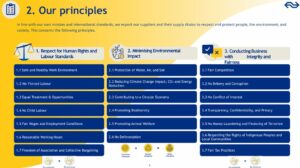
What does NS expect from suppliers?
NS expects its suppliers to integrate these principles into their operations and encourages their employees and suppliers to do the same. Suppliers are required to regularly evaluate their own processes and supply chains. If a supplier identifies issues within the supply chain related to human rights, environmental impact, or integrity and fair business practices, these must be reported to NS, after which appropriate measures will be taken. NS and its Supplier Code of Conduct are based on internationally recognised guidelines such as the OECD Guidelines, ILO Standards, the Universal Declaration of Human Rights, and the UN Guiding Principles on Business and Human Rights (UNGPs).
Grievance mechanism